Temasek's Maritime Legacy
Tracing seafarers’ journeys and the vibrant trade shaping the archipelago.
The Story of Temasek
Maritime Timeline: The Rise of Temasek
The Srivijayan Legacy
Pre-1299
Temasek serves as an outpost for the Srivijaya Empire. The Orang Laut are the primary inhabitants, acting as loyal naval forces who guide ships through the dangerous, reef-filled Long Ya Men (Dragon's Tooth Strait).
Establishment of the Port
1299 - 1330s
Sang Nila Utama arrives. According to the Malay Annals, he recognized the strategic value of the island. Commerce begins to boom as it becomes a "waiting point" for ships caught between monsoon seasons.
The Monsoon Engine
1330s - 1350s
Trade is dictated by the Monsoons:
NE Monsoon (Nov-Mar): Brings Chinese junks carrying silk and porcelain.
SW Monsoon (Jun-Sept): Brings Indian and Arab ships with spices and textiles.
Temasek becomes the central warehouse where these worlds meet.
Wang Dayuan's Account
1349
Chinese traveler Wang Dayuan records two distinct settlements: the fort on Fort Canning Hill and the maritime village at Long Ya Men. He notes the Orang Laut's dual role as both traders of local hornbill casques and fierce "pirates" who protect the port from rivals.
Conflict & Decline
1360s - 1390s
Temasek becomes a flashpoint between the Siam (Ayutthaya) and Majapahit empires. Frequent naval battles in the Straits lead to instability. The Orang Laut begin to disperse, eventually following Parameswara to found Malacca.
The "Straits" Geography & Commerce
The Straits of Temasek were more than just water; they were a high-stakes toll booth. Because the Straits were narrow and treacherous, foreign captains had to hire Orang Laut pilots to avoid shipwrecks.
ElementRole in Temasek's SuccessMonsoon WindsCreated a "forced stay" for traders, turning the island into a vibrant multi-cultural marketplace.Orang LautThe "Coast Guard" and logistics experts. They collected jungle produce (resins, gums) and sea products (pearls, tortoiseshell) for export.CommerceSpecialized in re-exporting. High-value items like Chinese ceramics were traded for local Southeast Asian spices and sandalwood.
Key takeaway for your novel: The "Straits of Temasek" weren't just a location; they were a living ecosystem. The Orang Laut didn't just live on the water—they were the water's power. Their ability to read the tides and the winds was the only thing standing between a merchant's fortune and a shipwreck.
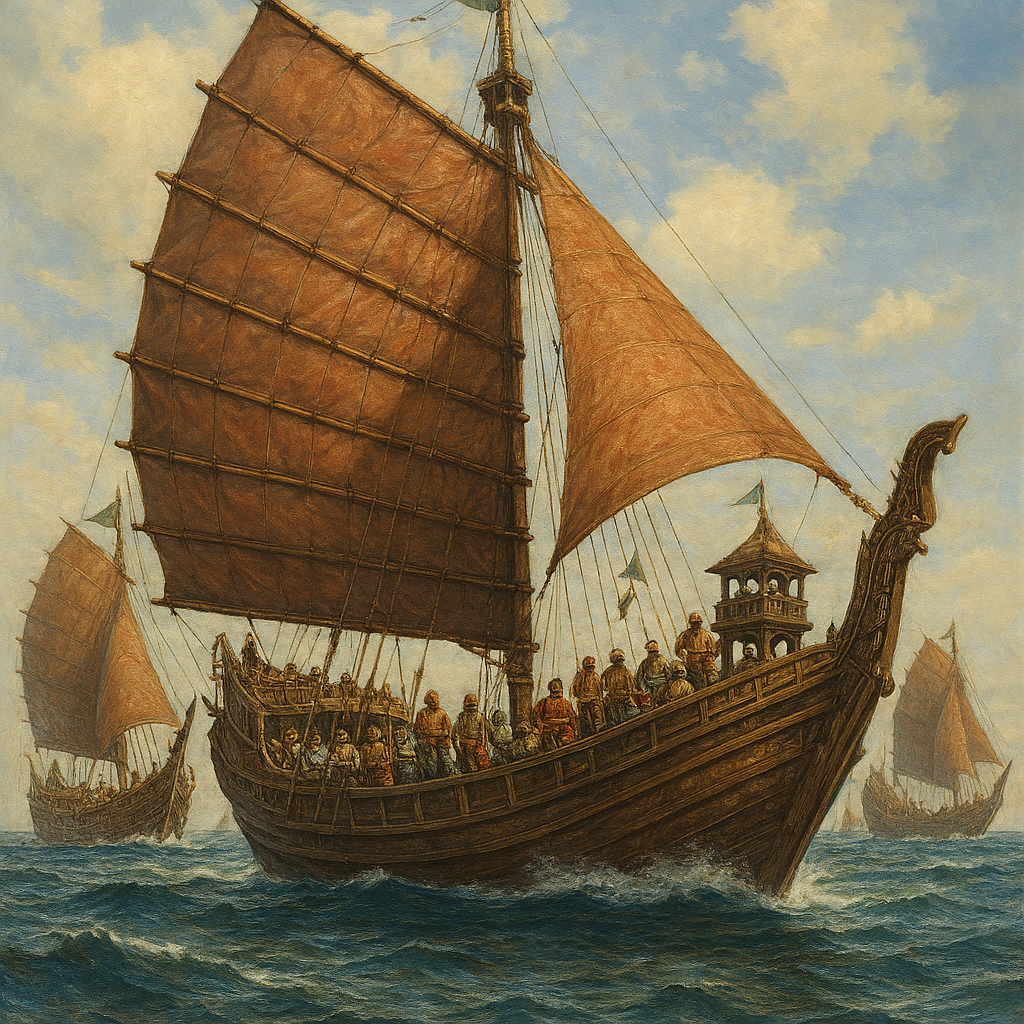
1. Jong Melayu (Kapal Kargo Samudera Gergasi)
Teknik Pasak & Ikat (Lashed-lug): Tiada paku besi. Papan disambung dengan pasak kayu dan diikat tali ijuk. Kapal menjadi fleksibel, lentur mengikut ombak, dan tidak mudah pecah.
Kulit Berlapis (Multi-layered Hull): Mempunyai 3 hingga 4 lapisan papan. Kebal daripada batu karang dan serangan awal, serta kekal kedap air walaupun lapisan luar rosak.
Layar Tanja: Layar segi empat senget yang membolehkan kapal belayar menongkah angin (menyisir angin dari sisi/hadapan) tanpa perlu menunggu perubahan monsun.
Kemudi Ganda: Sepasang kemudi di kiri dan kanan buritan (quarter rudders) untuk kawalan navigasi yang tajam di selat yang sempit.
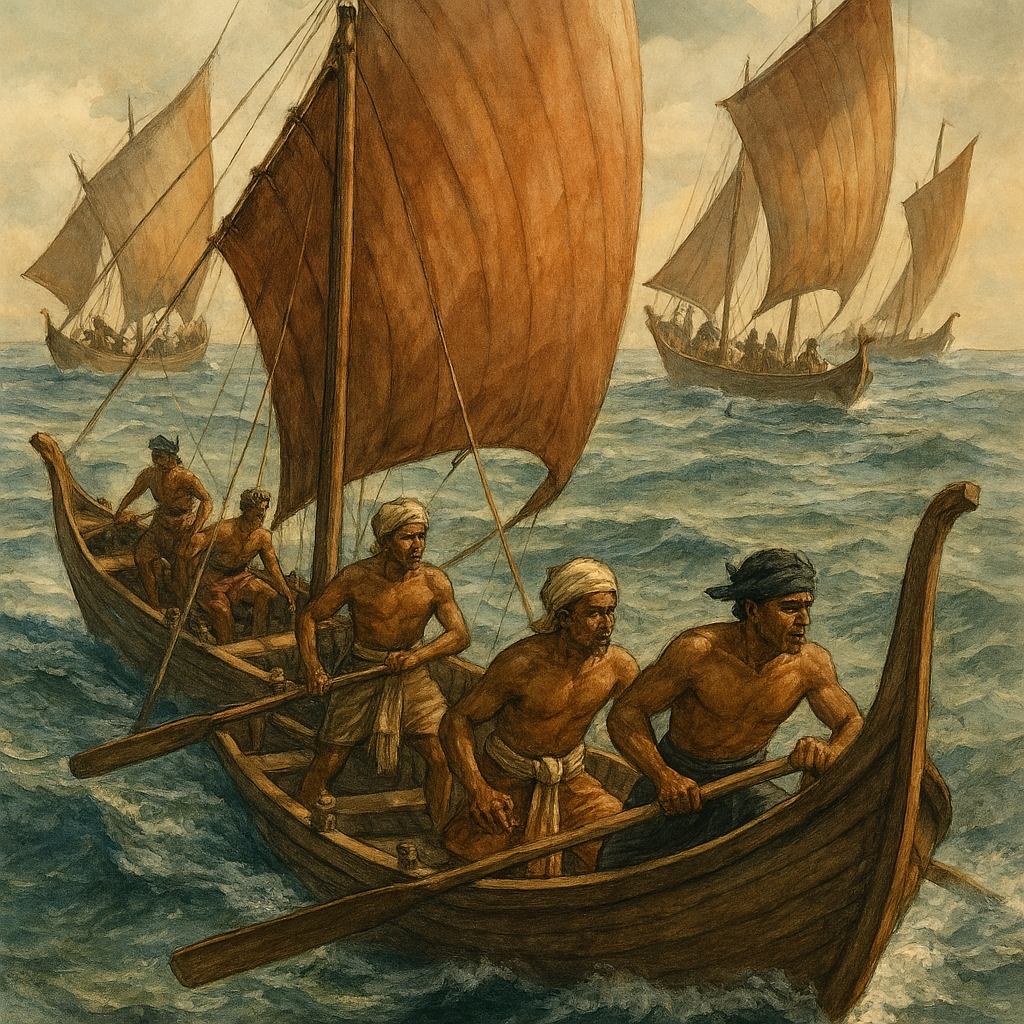
2. Perahu Orang Laut (Aset Taktikal Selat)
Dasar Rata (Flat-bottomed): Tiada lunas dalam (seperti Sampan Panjang). Boleh memecut di air cetek dan menyusup ke celah hutan bakau yang berlumpur.
Bahan Ringan & Damar: Dasar daripada batang pokok tunggal (perahu jalur) dengan dinding kayu meranti ringan. Sela papan ditutup dengan damar hutan sebagai pelekat kalis air.
Layar Kajang Lipat: Layar ringan daripada anyaman nipah/pandan. Mudah diturunkan dan disembunyikan sepantas kilat untuk strategi serbuan hendap.
Dayung Bersumbu: Digunakan secara berdiri/duduk apabila angin monsun mati. Memberikan pecutan tinggi untuk mengepung kapal asing di kawasan sempit seperti Long Ya Men.
Maritime Legacy
RUJUKAN
https://www.nlb.gov.sg/main/article-detail?cmsuuid=d24d6da6-0013-4a12-a6bc-68ad1497148e
https://en.wikipedia.org/wiki/Early_history_of_SingaporeINVESTIGATING HISTORY: Singapura Before 181
National Heritage Board.... https://www.nhb.gov.sg › activity-sheets › nms
https://epress.nus.edu.sg/sitereports/samis/content/11.A-Tale-of-two-sites-in-Temasek/
https://www.britannica.com/topic/history-of-Singapore
https://factsanddetails.com/southeast-asia/Singapore/sub5_7a/entry-3170.html
https://www.academia.edu/34357699/14th_Century_Singapore_The_Temasek_Paradigm
https://en.wikipedia.org/wiki/Early_history_of_Singapore
https://www.nlb.gov.sg/main/article-detail?cmsuuid=2683a39c-55bf-4627-8e95-2d6870e29478
https://en.wikipedia.org/wiki/Timeline_of_Singaporean_history
https://en.wikipedia.org/wiki/Early_history_of_Singapore
https://chinatown.sg/article/early-chinese-settlers-in-singapore/
https://www.nhb.gov.sg/nationalmuseum/whats-on/exhibition/once-upon-a-tide
https://www.youtube.com/watch?v=3eY5ADXlOno
https://coggle.it/diagram/WeIW7wCBZAABJKmI/t/singapore's-early-settlers-and-their-contributions
https://www.youtube.com/watch?v=_PC7pM3DJYQ
Primary school history lessons teach that Sir Stamford Raffles founded Singapore in 1819. But excavation at Fort Canning by NUS Professor John N Miksic and archaeologists has proved that a large, diverse community thrived here more than 700 years ago.Then there are the Orang Laut, indigenous sea people who "came from Singapore river", but were displaced by Raffles, said their descendant Mohamed Nassir Ismail. He grew up along Kallang River, in a village called Kampung Kuchai.This #SingaporeBicentennial, in the 2-part series Becoming Singapore, Eunice Olsen takes viewers on an evocative journey to meet people with rich and diverse stories that reflect how there’s not just one singular Singapore narrative, but a meeting of many tales.
https://www.researchgate.net/publication/261978721_EARLY_SINGAPORE_1300s-1819_EVIDENCE_IN_MAPS_TEXT_AND_ARTEFACTS_by_John_N_Miksic_Cheryl-Ann_Low_Mei_Gek
1819 & Before: Singapore's Pasts - ISEAS Publishing
https://singaporemagazine.sif.org.sg/Stories/Data/Stories/Digging-Up-History_2015Issue4
AI Overview
Analyze AI Overview
Long before its 19th-century founding as a British colony, Singapore was a bustling 14th-century trading hub known as Temasek. It was not a sleepy fishing village; it featured a multi-ethnic population of around 10,000. By 1819, the island was a sparse coastal settlement until it was transformed into a strategic free port. [1, 2, 3]
The 14th Century: Temasek and the Kingdom of Singapura
Original Name: Before it was called Singapura, the island was known as Temasek (meaning "Sea Town") in 13th- and 14th-century regional and Chinese texts.
Early Visitors: In the 1330s, Chinese trader Wang Dayuan visited and recorded two settlements: Banzu (on Fort Canning Hill) and Long Ya Men (Dragon's Tooth Strait near Keppel Harbour).
Sang Nila Utama: According to the Sejarah Melayu (Malay Annals), a Srivijayan prince named Sang Nila Utama arrived on the island, spotted a creature he mistook for a lion (singa), and renamed the settlement Singapura (Lion City).
A Hub of Trade: Archaeological excavations on Fort Canning Hill have revealed that pre-colonial Singapore was deeply integrated into the Maritime Silk Road. Artifacts include Chinese porcelain, Indian glass beads, and ancient coins.
Conflict and Decline: Toward the end of the 14th century, the Kingdom of Singapura was attacked by Siamese (Thai) or Javanese forces. The last ruler, Parameswara, fled to Malacca and established the Malacca Sultanate. By the time the British arrived, the island had largely transitioned back into an area inhabited by coastal communities and Orang Laut (sea people). [1, 2, 3, 4, 5, 6, 7, 8, 9]
1819: The Arrival of Stamford Raffles and British Colonization
Raffles' Arrival: On January 28, 1819, Sir Thomas Stamford Raffles, a Lieutenant-Governor of Bencoolen, arrived in Singapore seeking a strategic base to counter Dutch trading monopolies in the region.
The Treaty: On February 6, 1819, Raffles signed a preliminary treaty with Temenggong Abdul Rahman (a local chief) and Sultan Hussein Shah of Johor, allowing the British to set up a trading post.
Strategic Location: Raffles chose Singapore because of its deep natural harbour, its protective position at the southern entrance of the Straits of Malacca, and its history as a recognized local trading center.
Population Boom: Declaring Singapore a free port in 1819, the British abolished duties on trade. This instantly drew merchants, traders, and laborers from China, India, and the Malay Archipelago, causing the population to swell from roughly 150-200 people to over 10,000 within just a few years. [1, 2, 3, 4, 5]
You can read more about the island's pre-colonial history and artifacts by visiting the National Library Board of Singapore or examining the National Heritage Board's pre-colonial teaching resources.
A Thriving Singapore Before Stamford Raffles, From Orang ...
7 Feb 2019 — Primary school history lessons teach that Sir Stamford Raffles founded Singapore in 1819. But excavation at Fort Canning by NUS Pr...
4:08
YouTube·CNA Insider
INVESTIGATING HISTORY: Singapura Before 1819
I. POLITICAL CONNECTIONS When the British arrived in Singapore in 1819, they found relics dating back to the 14th century. Singapu...
National Heritage Board
Singapore and the Silk Road of the Sea
19 Feb 2018 — Throughout its history, Singapore has been regarded as an important port and trading hub, and is today one of the most significant...
NUS Arts and Social Sciences
Show all...AI can make mistakes, so double-check responses
https://en.wikipedia.org/wiki/Timeline_of_Singaporean_historyThe maritime history of Temasek is a story of how the monsoon winds turned a swampy island into a global "hinge" for world trade. At the heart of this was the Orang Laut (Sea People), whose mastery of the Straits of Temasek (Straits of Singapore) provided the muscle and security needed for commerce to thrive.
Ancient Maritime Trade Routes. Source: Facts and Details / EARLY HISTORY OF SINGAPORE: LEGENDS, ARCHAEOLOGY AND 14TH CENTURY ...
Temasek as a Global Port. Source: Mothership.SG / In 1300s S'pore, “pirates” robbed passing ships & slaughtered ...
The Orang Laut: Guardians of the Strait. Source: Wikipedia / Orang Laut - Wikipedia
Junks Carrying Global Goods. Source: Pictures from History / Universal Images Group via Getty Images
Copyright © 2026 GSDC.


Secure payment • Delivered in 48–72 hours
“Penafian | Disclaimer”
“Maklumat kesihatan, agama,motivasi di laman ini adalah untuk tujuan pendidikan umum sahaja. Sila rujuk profesional kesihatan dan pihak berkuasa agama untuk nasihat khusus.”
“Health, religious, motivation information on this website is for general educational purposes only. Please consult qualified professionals and authorised religious authorities for specific advice.”12
SILA IKUTI DAN KONGSI